MBN-Company
MBN-Company
MBN-Company
MBN-Company
MBN-Company
MBN-Company
MBN-Company
MBN-Company
Information of news
  • Views: 142
  • Author: mbncom
  • Date:

5 Electrical Maintenance Tasks You Should Be Doing

Category: News

Electricity is the lifeblood of modern society, powering everything from our homes to our workplaces. However, electrical systems can quickly become dangerous and unreliable without proper maintenance. Whether you’re a homeowner, business owner, or facilities manager, staying on top of your electrical maintenance tasks is crucial to ensure safety and reliability. Keep reading to explore the top electrical maintenance tasks you should be doing to keep your electrical systems in tip-top shape.

1. Visual Inspection

Visual inspection is an essential task that should be carried out by electrical maintenance personnel to ensure that electrical equipment and systems are in good working condition. This task involves a thorough visual examination of electrical components, wiring, and other parts of an electrical system to identify any signs of wear, damage, or other issues that may compromise the safety and reliability of the system.

During a visual inspection, maintenance personnel will look for signs of corrosion, cracks, rust, or other damage to electrical components. They should also check for loose connections, exposed wires, and any other signs of wear and tear that could lead to electrical faults or hazards. Furthermore, a visual inspection can help identify potential fire hazards, such as overheating electrical equipment, that could cause catastrophic property damage and endanger lives. Additionally, this task can identify any non-compliance issues with local, state, or federal regulations that may lead to fines, penalties, or legal liabilities.

Regular visual inspections are essential to maintain the integrity and safety of electrical systems. Timely detection of problems through visual inspection can prevent catastrophic failures and prolong the life of electrical equipment, leading to significant cost savings for businesses and individuals. To ensure that visual inspection is carried out effectively, you need well-trained personnel who understand the importance of this task and can identify potential hazards. Also, using proper equipment and following established procedures and guidelines is crucial to ensure accurate and consistent results.

2. Testing Electrical Equipment

Testing electrical equipment ensures the safety and reliability of electrical systems. This task involves the use of specialized equipment designed to check for any faults or defects in electrical equipment. During the testing process, various parameters of the equipment, such as voltage, current, resistance, insulation resistance, and continuity, are measured to ensure that the equipment is functioning correctly and is safe to use. The testing process can be done manually or automated using specialized test equipment.

One of the main reasons why testing electrical equipment is important is that it helps prevent electrical accidents. Electrical equipment that is not functioning correctly can pose a significant hazard to workers and the general public. Faulty electrical equipment can cause electrical shocks, fires, or even explosions. By testing equipment regularly, technicians can identify potential faults and defects and repair them before they cause any accidents or damage.

Testing electrical equipment also helps to ensure that equipment is functioning efficiently. Equipment that is not working correctly can cause unnecessary energy consumption, leading to increased energy bills. Regular testing can identify equipment that is not functioning efficiently, enabling it to be repaired or replaced to prevent waste of energy. Additionally, testing electrical equipment can help prolong the equipment’s lifespan. Regular testing can detect faults and defects that, if left unrepaired, can cause permanent damage to the equipment. Repairing these faults can help extend the equipment’s life, saving the replacement cost.

3. Cleaning Electrical Equipment

Cleaning electrical equipment involves removing any debris or foreign substances present on the equipment’s surface or inside its components. This can be achieved through various methods, depending on the type and location of the equipment. For example, wiping the surface with a clean cloth or using a vacuum cleaner to remove dust and dirt from the ventilation system.

Dirt, debris, and other buildup can cause the equipment to overheat and become less efficient. Over time, this can lead to a decrease in performance and even a complete breakdown of the equipment. Additionally, dirt and debris can be conductive, causing electrical arcing or short circuits, which can be dangerous and cause fires or electrocution.

Cleaning electrical equipment is not something that inexperienced individuals should do, as it can be hazardous if not done correctly. Hiring a professional with the necessary knowledge and experience to carry out this task safely and effectively is important. A professional will use specialized equipment, such as vacuums and brushes, to remove dirt and debris from the equipment without causing damage. They will also have the proper protective gear to prevent injury from electrical shocks or exposure to hazardous materials.

4. Lubricating Moving Parts

The various moving parts of electrical equipment, such as motors and generators, must be lubricated periodically. Regularly lubricating electrical equipment’s moving parts helps reduce wear and tear on the components. Friction between moving parts causes heat, which can lead to component failure over time. The lubricant acts as a protective barrier, reducing friction and keeping the components running smoothly. Proper lubrication also reduces noise and vibration, which can affect the performance of the equipment.

This job must be done using the right lubricant. The lubricant should be compatible with the equipment’s materials and operating conditions. Generally, lubricants used for electrical equipment should have a high dielectric strength to prevent electrical breakdown and should be resistant to moisture, dust, and other contaminants.

5. Electrical Upgrade

Electrical upgrade refers to the process of updating or replacing outdated electrical components, wiring, or systems in a building or home to ensure that they meet modern safety standards and can handle the demands of today’s electrical devices and appliances. Electrical upgrades may include replacing old wiring, installing new circuits or panels, upgrading the electrical service, or improving the overall electrical infrastructure of a building.

There are several reasons electrical upgrades are important. First and foremost, they help to ensure the safety of the building’s occupants. Outdated electrical systems can be a fire hazard, as old wiring or overloaded circuits can easily spark and cause a fire. Another reason why electrical upgrades are important is that they can improve energy efficiency. Old electrical systems are often inefficient and use more electricity than necessary.

When it comes to upgrading the electrical system, a professional electrician can be your best ally. A professional will start by assessing the current electrical infrastructure and identifying potential problems or improvement areas. They will then work with the homeowner or business owner to develop a plan for upgrading the system, which may include rewiring the entire home, installing new electrical panels or circuits, or upgrading the electrical service.

Tags for this article: Electrical Maintenance, MBN Co., Electrical, electrical

Information of news
  • Views: 171
  • Author: mbncom
  • Date:

Microchip Ramps Security on Touchscreen Controllers for EV Chargers

Category: News

Touchscreens and their controllers used in outdoor EV charging stations must withstand adverse weather conditions and offer a reliable way to transfer customer data to the operational backend. For instance, moisture may condense on a touchscreen surface and cause inaccurate readings that are sent to the touchscreen controller.

Additionally, “false touches” can happen if significant water droplets or moisture condense on a touchscreen surface. Microchip's new touchscreen controllers, the ATMXT2952TD-C2UEN, can compensate for these effects and eliminate the possibility of false touches, even with up to 22 mm of water condensation.


ATMXT2952TD

Condensation on touchscreens can adversely affect performance. Image used courtesy of Microchip


The device also features various other noise-suppression features to compensate for situations arising from multi-touch interactions. These include a lens-bend algorithm to adjust for warping in the touchscreen display, touch suppression to mitigate effects from unwanted screen touches, and self-capacitance sensing to respond to both bare finger touches and glove usage.

The product brief mentions that the device can support up to a 21-inch touchscreen display and has automatic touch sensor diagnostics, which can be reported using a dedicated output pin.   

Another concern with outdoor touchscreens besides the weather is vandalism. Consequently, the ATMXT2952TD 2.0 can be used with IK10-standard, 6-mm glass displays. An IK10 display meets standard IEC 62262 level ten, which indicates the highest level of protection against external mechanical impacts. 


K Code

IK00

IK01

IK02

IK03

IK04

IK05

IK06

IK07

IK08

IK09

IK10

Impact Energy (Jules) ––

0,14

0,2

0,35

0,5

0,7

1 2 5 10 20
Weight (g) –– 200 200 200 200 200 500 500 1700 5000 5000
Impact Height (cm) ––

7.5

10

17.5

25 35 20 40

29.5

20 40


The 2.0 Family Enhances Security Features 

The new MXT2952TD 2.0 touchscreen controllers mitigate the threat of malicious actors gaining access to sensitive customer information by encrypting touch information and cryptographically authenticating software updates. The new 2.0 family allows customers to integrate secure credit card payment services into a touchscreen-based EV charging station.

The 2.0 family allows customers to run firmware directly on the controller, eliminating the chance of man-in-the-middle attacks that can occur when, for example, an RFID reader and touchscreen controller are on different physical PCBs.


Man-in-the-middle attacks

Man-in-the-middle attacks are a particular vulnerability of complex electronic systems. Image used courtesy of Invicti


A man-in-the-middle attack allows a malicious actor to access personal information by intercepting communication between two elements. Using the 2.0 family, however, firmware can run directly on the controller, eliminating the need for separate RFID and controller boards. In one scenario, the user may simply enter a secure PIN on the touchscreen and authenticate directly for payment.

CONTENT FROM PARTNERS

Unlocking the Power of Infineon Automotive Microcontrollers: Driving Safety, Sustainability and Innovation for Commercial, Construction and Agriculture Vehicles

Content from Infineon Technologies

Information of news
  • Views: 270
  • Author: mbncom
  • Date:

Breakthrough GaN Power Supply IC with World’s Highest Voltage Introduced by Power Integrations

Category: News

The InnoSwitch line boasts synchronous rectification, FluxLink safety-isolated feedback, and a range of switch options, including 725 V silicon, 1700 V silicon carbide, and now PowiGaN variants in 750 V, 900 V, and 1250 V.

One of the standout features of Power Integrations’ proprietary 1250 V PowiGaN technology is its remarkably low switching losses, measuring less than one-third of those found in equivalent silicon devices at the same voltage. This attribute results in a staggering power conversion efficiency of up to 93%, enabling the creation of highly compact flyback power supplies capable of delivering up to 85 W without the need for a heatsink.

Radu Barsan, the Vice President of Technology at Power Integrations, highlighted the company’s commitment to pushing the boundaries of high-voltage GaN technology. He noted, “Power Integrations continues to advance the state of the art in high-voltage GaN technology development and commercial deployment, rendering even the best high-voltage silicon MOSFETs obsolete along the way. We were first to market with high-volume shipments of GaN-based power-supply ICs in 2019, and earlier this year introduced a 900-volt version of our GaN-based InnoSwitch products. Our ongoing development of higher voltage GaN technology, illustrated here by our new 1250 V devices, extends the efficiency benefits of GaN to an even wider range of applications, including many currently served by silicon-carbide technology.”

Designers incorporating the InnoSwitch3-EP 1250 V ICs into their projects can confidently specify an operating peak voltage of 1000 V, allowing for an industry-standard 80% de-rating from the 1250 V absolute maximum. This substantial headroom is particularly valuable in challenging power grid environments where robustness is essential to defend against grid instability, surges, and other power perturbations.

Power Integrations, a leader in high-voltage integrated circuits for energy-efficient power conversion, has introduced the world’s highest-voltage, single-switch gallium-nitride (GaN) power supply integrated circuit (IC). This new release features a remarkable 1250-volt PowiGaN switch. These InnoSwitch3-EP 1250 V ICs represent the latest additions to Power Integrations’ InnoSwitch family, designed for off-line constant voltage/constant current (CV/CC) QR flyback switcher ICs.

Information of news
  • Views: 245
  • Author: mbncom
  • Date:

Renewable Energy Is Great—but the Grid Can Slow It Down

Category: News

SAY YOU WANT to build a wind farm. You find a nice empty knoll in northern Vermont, where the breeze blows steadily and the neighbors don’t complain about sullied views. (A damn miracle, in other words.) You line up investors, get the right permits, and prepare to install your turbines. Then you hit snag: power lines. There aren’t enough in rural Vermont; they’re all in Boston, along with the people and their Teslas. So you’ve got a problem. The wind is blowing here, but there’s no way to get its green energy there.

Since 1889, when the US got its first long-distance power line (it traversed a whopping 14 miles), the grid largely has been set up for energy that’s consumed relatively close to where it is produced. There are exceptions—like hydropower that reaches cities from far-flung dams—but for the most part, it has been a century of linking coal and gas plants with people living nearby. But now, with wind farms dotting mountain ridges and solar plants sprawling in the desert, distance is more common. 

The wires aren’t ready for it. Researchers at Princeton University estimate that the country’s high-voltage transmission capacity needs to grow by 60 percent in the next decade to meet its clean energy goals. “The grid that we have wasn’t designed for what we do with it now, let alone what we want to do with it, with all sorts of renewables,” says Seth Blumsack, an economist who studies the grid at Penn State University.

In many parts of the country, wind and solar are already the cheapest ways to produce energy, but transmission is a limiting factor, explains Kerinia Cusick, cofounder of the Center for Renewables Integration, a nonprofit that advocates modernizing the grid for green energy. That means that in places like rural Vermont, wind farm owners are frequently ordered to shut down when a healthy breeze is blowing—a move known as “curtailment”—because there’s too much power coming over the wires. 

For plants that are yet to be built, the situation is even worse, because grid constraints mean backers must string new lines, and pay for them, before installing turbines or solar panels. Each year, hundreds of renewable energy projects stall in advanced planning stages due to delays in upgrading transmission lines and the cost of making those upgrades.

“There’s a very likely risk that’ll kill your project,” says Hudson Gilmer, chief executive of LineVision. Gilmer’s company attacks the problem from another angle: make the existing grid carry more power. Even when plans for a new line are approved, there’s no guarantee it actually happens. Nobody wants massive power lines draped over their backyard or across an endangered wetland. So Gilmer looks for ways to eke more power out of the lines where congestion is a big problem.

Information of news
  • Views: 183
  • Author: mbncom
  • Date:

Two-channel 16bit 125Msample/s PCIe digitiser board

Category: News

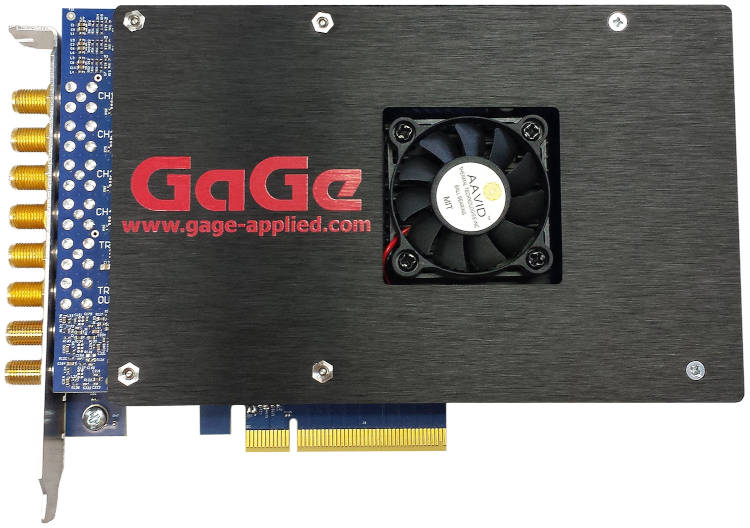
GaGe has filled out its line of PCIe digitiser boards – essentially ADCs for PCs – with three new dual-channel models: one with with 250MHz bandwidth and 14bit 500Msample/s sampling, and two 125MHz 250Msample/s models, one with 16bit resolution and the other 14bit.


GaGe-Digitizer-Razor-Express PCIe card

The “digitisers boast ENOB [effective number of bits] of ~11+ typical”, according to the company.

Inputs are 50Ω or 1MΩ, there is 8Gbyte (4Gsample) of memory as standard (upgrade to 16Gbyte 8Gsample), and the PCIe interface is Gen3 x8.

“At the same time, we are announcing price reductions on our 16bit, 500Msample/s two and four-channel models, said company spokesman Gerald Allgaier.

Control software is available for Windows, and SDKs (software development kits) are available for C/C#, Python, LabVIEW and MATLAB.

“With eXpert PCIe Data Streaming Firmware, acquired data can be simultaneously streamed to host PC memory via the PCIe interface at sustained rates for real-time continuous signal processing or signal recording operations,” said GaGe which, for example for the 14bit 25MHz 250Msample/s model, it claims 6Gbyte/s transfer from on-board memory and 1Gbyte/s real-time sustained streaming to the host.

Find the 14bit 25MHz 250Msample/s digitiser here – be prepared to separate similar ‘Razor…’ brand names when seeking the others.

GaGe is a brand of Californian manufacturer Vitrek, which now covers products previously branded Signatec and KineticSystems.

Information of news
  • Views: 187
  • Author: mbncom
  • Date:

Extended capabilities support next-generation RF testing

Category: News

NI, formerly known as National Instruments, has attended to both ends of this spectrum with its vector signal transceiver (VST) concept, first introduced in 2012. The VST combines an RF signal generator, RF signal analyzer and a field-programmable gate array (FPGA) onto a single PXI module to serve a wide range of RF design and test applications — particularly those requiring an RF stimulus and RF response.

In early September, the company announced new options and extended capabilities for its third-generation PXI VST, the PXIe-5842, designed to support testing and validation of products in aerospace and defense applications while also offering traditional RF capabilities such as spectrum analysis, signal analysis and signal generation.

According to the company, the PXIe-5842 delivers precise control over signal parameters and real-time analysis with extended frequency coverage from 30 MHz to 26.5 GHz. Enhancements also include up to 2 GHz of instantaneous bandwidth (IBW) and upgraded local oscillator (LO) offset mode with improved average noise density. The new version enables both digital and analog pulse modulation capabilities, and its 16-lane high-speed serial interface enables low-latency digital I/Q data streaming at rates up to the full 2 GHz IBW of the instrument, with future-proofing to 4 GHz. When combined with PXI-based FPGA co-processors from NI, the VST can emulate RF environments or other RF devices for system-level tests.

NI said that the new capabilities build upon the flexibility and versatility of the PXIe-5842, making it useful for generic RF testing and particularly suitable for aerospace and defense applications.

“Next generation radar, electronic warfare, and communications technologies require radically different methods than the status quo for validation and test on tight schedules,” said Luke Schreier, vice president and general manager of NI’s Aerospace, Defense and Government Business. “The performance we have unlocked in this third-generation vector signal transceiver is critical to future-proofing your test capability, exploiting the insight that comes from rich test data and architecting a truly software-centric approach to electromagnetic spectrum operations. It is the culmination of decades worth of investment in PXI, RF technology and software from NI designed to maximize your product’s performance through test.”

Information of news
  • Views: 181
  • Author: mbncom
  • Date:

Newly-Developed Optical Fiber Can Carry More Than 10 Million Fast Home Internet Connections

Category: News

Researchers have set a new speed record for an industry standard optical fiber, achieving 1.7 Petabits over a 67 km length of fiber. The fiber, which contains 19 cores that can each carry a signal, meets the global standards for fiber size ensuring that it can be adopted without massive infrastructure change.

The 19-core optical fiber. Image credit: Rademacher et al., doi: 10.1364/OFC.2023.Th4A.4.

The 19-core optical fiber. Image credit: Rademacher et al., doi: 10.1364/OFC.2023.Th4A.4.

All the world’s internet traffic is carried through optical fibers which are each 125 microns thick.

These industry standard fibers link continents, data centers, mobile phone towers, satellite ground stations and our homes and businesses.

Back in 1988, the first subsea fiber-optic cable across the Atlantic had a capacity of 20 Megabits or 40,000 telephone calls, in two pairs of fibers. Known as TAT 8, it came just in time to support the development of the World Wide Web. But it was soon at capacity.

The latest generation of subsea cables such as the Grace Hopper cable, which went into service in 2022, carries 22 Terabits in each of 16 fiber pairs. That’s a million times more capacity than TAT 8.

But it’s still not enough to meet the demand for streaming TV, video conferencing and all our other global communication.

“Decades of optics research around the world has allowed the industry to push more and more data through single fibers,” said Macquarie University researcher Simon Gross.

“They’ve used different colors, different polarizations, light coherence and many other tricks to manipulate light.”

Most current fibers have a single core that carries multiple light signals. But this current technology is practically limited to only a few Terabits per second due to interference between the signals.

“We could increase capacity by using thicker fibers,” Dr. Gross said.

“But thicker fibers would be less flexible, more fragile, less suitable for long-haul cables, and would require massive reengineering of optical fiber infrastructure.”

“We could just add more fibers. But each fiber adds equipment overhead and cost, and we’d need a lot more fibers.”

To meet the exponentially growing demand for movement of data, telecommunication companies need technologies that offer greater data flow for reduced cost.

The newly-developed fiber contains 19 cores that can each carry a signal.

“We’ve created a compact glass chip with a wave guide pattern etched into it by a 3D laser printing technology,” Dr. Gross said.

“It allows feeding of signals into the 19 individual cores of the fiber simultaneously with uniform low losses.”

“Other approaches are lossy and limited in the number of cores.”

The authors presented their results in March 2023 at the Optical Fiber Communication Conference (OFC) 2023 in San Diego, California, the United States.

_____

Georg Rademacher et al. 2023. Randomly Coupled 19-Core Multi-Core Fiber with Standard Cladding Diameter. OFC 2023, paper # Th4A.4; doi: 10.1364/OFC.2023.Th4A.4

Information of news
  • Views: 184
  • Author: mbncom
  • Date:

Guide to Spice Simulation for Circuit Analysis and Design

Category: News

Information of news
  • Views: 191
  • Author: mbncom
  • Date:

HOMETECHNOLOGY NEWS Innovative High-Power Thermoelectric Device Poised to Revolutionize Cooling in Next-Generation Electronics

Category: News

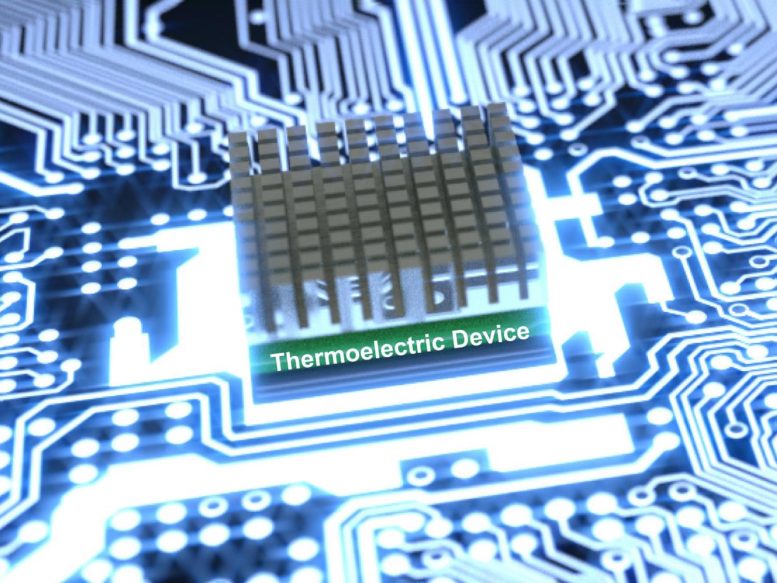
Penn State researchers have created a thermoelectric cooler that significantly improves cooling power and efficiency for future high-power electronics. The device uses half-Heusler alloys and a unique annealing process to yield higher cooling power density and carrier mobility.

Revolutionary Thermoelectric Cooler for Next-Generation Electronics

The development of next-generation electronics, set to feature smaller yet more powerful components, calls for innovative cooling solutions. A newly designed thermoelectric cooler, the brainchild of Penn State scientists, notably improves cooling power and efficiency compared to existing commercial thermoelectric units. This development, the researchers believe, could be instrumental in managing heat in upcoming high-power electronics.

Bed Poudel, research professor in the Department of Materials Science and Engineering at Penn State, expressed optimism about the device’s future applications. He said, “Our new material can provide thermoelectric devices with very high cooling power density. We were able to demonstrate that this new device can not only be competitive in terms of technoeconomic measures but outperform the current leading thermoelectric cooling modules. The new generation of electronics will benefit from this development.”

Half-Heusler Materials Boost Cooling Power Density

Half-Heusler materials may provide a boost in cooling power density of thermoelectric devices and provide a cooling solution for next generation of high-power electronics. Credit: Courtesy Wenjie Li

Thermoelectric Coolers: Mechanism and Challenge

Thermoelectric coolers function by transferring heat from one side of the device to the other upon the application of electricity. This process results in a module with distinctly cold and hot sides. By placing the cold side on heat-generating electronic components such as laser diodes or microprocessors, the surplus heat can be pumped away, effectively controlling the temperature. However, as these components continue to grow more powerful, thermoelectric coolers will also need to expel more heat.

The newly developed thermoelectric device demonstrated a 210% increase in cooling power density compared to the leading commercial device, constructed from bismuth telluride. Additionally, it potentially maintains a similar coefficient of performance (COP), the ratio of useful cooling to the energy required, as reported in the journal Nature Communications.

Addressing Thermoelectric Cooling Challenges

Shashank Priya, vice president for research at the University of Minnesota and a co-author of the paper, shed light on the new device’s capabilities. He stated, “This solves two out of the three big challenges in making thermoelectric cooling devices. First, it can provide a high cooling power density with a high COP. This means a small amount of electricity can pump a lot of heat. Second, for a high-powered laser or applications that require a lot of localized heat to be removed from a small area, this can provide the optimum solution.”

Innovative Half-Heusler Material in the New Device

This novel device is constructed from a compound of half-Heusler alloys, a class of materials with distinctive properties promising for energy applications like thermoelectric devices. These materials offer considerable strength, thermal stability, and efficiency.

The researchers employed a special annealing process — which manipulates how materials are heated and cooled — enabling them to alter and regulate the material’s microstructure to remove defects. This method had not been previously used to fabricate half-Heusler thermoelectric materials.

The Annealing Process and Its Effects

The annealing process also substantially increased the material’s grain size, leading to fewer grain boundaries — regions in a material where crystallite structures meet and that reduce electrical or thermal conductivity.

Wenjie Li, assistant research professor in the Department of Materials Science and Engineering at Penn State, described this transformation: “In general, half-Heusler material has a very small grain size — nano-sized grain. Through this annealing process, we can control the grain growth from the nanoscale to the microscale — a difference of three orders of magnitude.”

Reducing the grain boundaries and other defects significantly enhanced the carrier mobility of the material, influencing how electrons can move through it, which resulted in a higher power factor. This power factor is especially crucial in electronics-cooling applications as it determines the maximum cooling power density.

High Thermal Management Applications and Future Implications

Li further explained the relevance of this advancement, stating, “For instance, in laser diode cooling, a significant amount of heat is generated in a very small area, and it must be maintained at a specific temperature for the optimal performance of the device. That’s where our technology can be applied. This has a bright future for local high thermal management.”

In addition to the high power factor, the materials produced the highest average figure of merit, or efficiency, of any half-Heusler material in the temperature range of 300 to 873 degrees Kelvin (80 to 1,111 degrees Fahrenheit.) This indicates a promising strategy for optimizing half-Heusler materials for near-room-temperature thermoelectric applications.

“As a country, we are investing a lot in the CHIPS and Science Act, and one problem might be how the microelectronics can handle high-power density as they get smaller and operate at higher power,” Poudel said. “This technology may be able to address some of these challenges.”

Reference: “Half-Heusler alloys as emerging high power density thermoelectric cooling materials” by Hangtian Zhu, Wenjie Li, Amin Nozariasbmarz, Na Liu, Yu Zhang, Shashank Priya and Bed Poudel, 6 June 2023, Nature Communications.
DOI: 10.1038/s41467-023-38446-0

Also contributing were Amin Nozariasbmarz, assistant research professor and Na Liu and Yu Zhang, postdoctoral scholars, Penn State; and Hangtian Zhu, associate professor, Institute of Physics, Chinese Academy of Sciences, Beijing. 

Researchers on the project were supported by grants from the Office of Defense Advanced Research Projects Agency, Office of Naval Research, U.S. Department of Energy, National Science Foundation and the Army Small Business Research Program. 

Information of news
  • Views: 162
  • Author: mbncom
  • Date:

Silicon Labs Rolls Dual-band SoC for Long-range Wireless Protocols

Category: News

Silicon Labs Rolls Dual-band SoC for Long-range Wireless Protocols


The Internet of Things (IoT) and the general emergence of connected devices have led to a significant increase in the importance of wireless hardware. In particular, to meet the varying needs of IoT devices, the demand for wireless hardware that can simultaneously support multiple wireless protocols has skyrocketed.
 

Last week, Silicon Labs answered this call with the release of a new dual-band wireless SoC that is meant specifically to support long-range wireless protocols and Amazon Sidewalk.


In this article, we’ll talk about Amazon Sidewalk as well as Silicon Labs’ new wireless SoC offering.


Amazon Sidewalk

In the world of IoT and the smart home, one of the most exciting technologies to emerge in recent years is Amazon Sidewalk. As covered in previous All About Circuits articles, Amazon Sidewalk is a community-based network introduced by Amazon with the goal of expanding connectivity for low-bandwidth devices such as smart lights, sensors, and various Internet of Things (IoT) devices.

By leveraging Bluetooth Low Energy (BLE) and the 900 MHz LoRa spectrum, Sidewalk establishes a means for these devices to communicate not only with each other but also with Amazon's servers, even when they are beyond the range of a user's Wi-Fi network.


The fundamental idea behind Sidewalk involves the creation of a long-range network that operates on low bandwidth. While third-party IoT devices don't directly interact with one another, they can utilize Ring/Echo devices as bridges to transmit their communications. However, it's important to note that these Echo/Ring devices, acting as intermediaries, do not engage in direct communication with one another.

An intriguing aspect of Amazon Sidewalk is its shared nature. By choosing to participate, your Amazon devices can contribute to extending the network's coverage area, benefiting a larger community.

For instance, if your neighbor's Wi-Fi signal doesn't reach your backyard, but they possess Sidewalk-enabled devices, your own devices can connect to their network, and vice versa. This collaborative approach creates a network that fosters mutual advantages for all residents within the neighborhood.


Silicon Labs’ New SoC

Silicon Labs’s new SoC, called the EFR32FG28, is a dual-band, sub-GHz wireless + 2.4 GHz BLE SoC that offers a number of unique features for a wireless SoC. 

One notable feature of the new piece of hardware, according to the datasheet, is that it is a multiprotocol device designed to support long-range communication. With a low-power RF transceiver (as low as 33 µA/MHz in Active Mode at 39 MHz and 1.3 µA in DeepSleep) as well as integrated power amplifiers with up to 20 dBm output, the new device can support protocols such as Amazon Sidewalk, Wi-SUN, sub-GHz, and 2.4 GHz BLE.


From a compute perspective, the device is built around a 32-bit, 78 MHz Arm Cortex-M33 core with up to 1024 kB of flash and up to 256 kB of RAM. More notably, Silicon Labs claims that this device is the industry’s first sub-GHz SoC to integrate an AI/ML hardware accelerator. The accelerator in question is specifically a matrix-vector processor and is said to allow for edge computing in IoT devices.

Additionally, the device features a number of key MCU peripherals including 16-bit and 32-bit timers/counters, watchdog timers, 2x analog comparators, 2x DACs, and an ADC.


A Swiss Army Knife

According to Silicon Labs, their intention with this product was to create a “swiss army knife” wireless SoC. Between dual-band support for a variety of wireless protocols, a versatile computing core with a slew of peripherals, and an integrated AI/ML accelerator, it certainly seems that the EFR32FG28 is a device that can serve the needs of many different designs and use cases. 


Prev Next

Related Posts :

    Contact Us :

    Headquarter: Unit:15-No:12-Gandhi 19-Gandhi Blv-Tehran-Iran
    Postal Code: 1517874438
    Telephones: (+98-21)44237763 (+98-21)88668972 (+98-21)88663258
    Fax NO: (+98-21)89770683
    E-mail : Info@mbncompany.com
    Laboratory and instrumentation section: mbnasir.co@gmail.com
    Electrical section: mbnco@outlook.com
    After sales section: support@mbncompany.com

    Google Map :


    سئو | کاشت مو | صندلی پلاستیکی | بادکنک آرایی